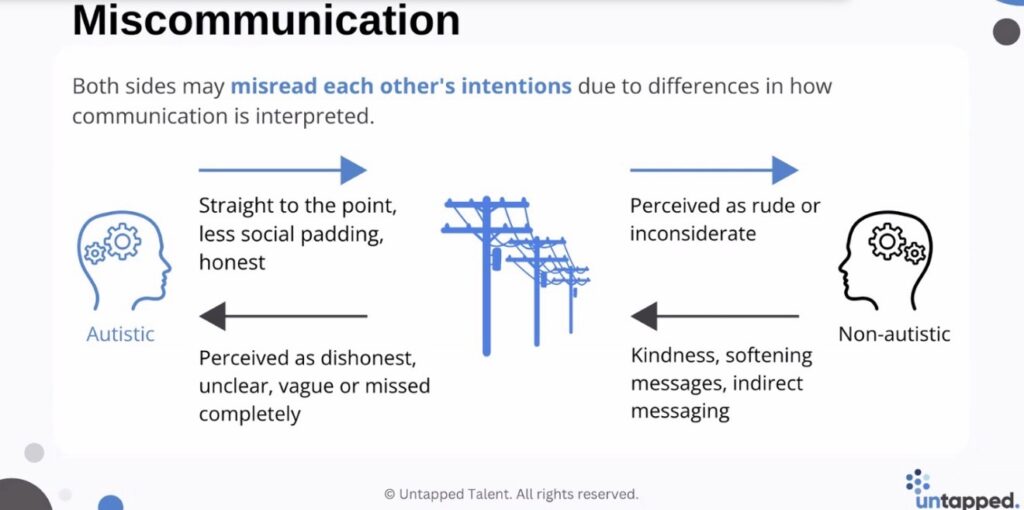
There is a diagram making the rounds in neurodiversity education circles. It shows two figures facing each other across a tangle of wires. On one side, an autistic communicator sends a signal: direct, economical, honest. On the other side, the message can arrives distorted, perceived as rude, even aggressive. The arrow runs the other way too. A non-autistic communicator sends warmth wrapped in softening language and indirect cues. It arrives on the other side garbled: vague, dishonest, or simply missed.
The diagram is clinical and neat, as diagrams tend to be. What it cannot capture is the accumulated weight of a lifetime spent on the wrong side of that wire.
Both sides believe they are communicating clearly. Both sides are right. That is the problem.
For decades, the prevailing framework was that autistic people had a deficit, a failure to read social cues, to perform empathy correctly, to know how the game was played. The burden of translation fell entirely on one side. Fit in or be misread. Mask or be misunderstood. The cost of that bargain, paid quietly over years, is immense.
But something interesting happened when researchers started studying autistic people communicating with each other. The communication worked. The friction largely disappeared. Which means the difficulty was never about one group being broken. It was about two different operating systems trying to exchange data without a shared protocol.
The researcher Damian Milton named this the Double Empathy Problem. The insight is deceptively simple: when two people from different social groups interact, both parties struggle to understand the other. The struggle is mutual. It has always been mutual. We just only ever pathologized one side of it.
Think about what that reframe actually means. It means the person who said exactly what they meant, without decoration or deflection, was not being rude. They were being honest in a register that reads as rude to someone expecting the usual social upholstery. It means the person who softened their message into a gentle implication was not being dishonest. They were being kind in a register that arrives as noise, or doesn’t arrive at all.
Nobody was failing. The wire between them was.
The question worth sitting with is not who communicates correctly, but who has ever been asked to translate.
Most workplaces, social structures, and institutions were built around one style. The cost of navigating them falls on those whose natural register doesn’t match, not because their way of communicating is inferior, but because it is in the minority. That is a structural condition, not a personal one. Naming it clearly is the first useful step.
The diagram shows two heads separated by tangled infrastructure. What it quietly implies is that the infrastructure is the variable. The humans on both sides are doing exactly what they are built to do. If we want understanding to move cleanly between them, we have to work on the wire.
That work starts with dropping the assumption that one way of speaking is the default and everything else is deviation. It starts with genuine curiosity about how a message was sent, not just how it landed. It starts, honestly, with the humbling recognition that your own communication style is also a style legible to some, opaque to others and not the neutral baseline you may have always assumed it to be.


0 Comments