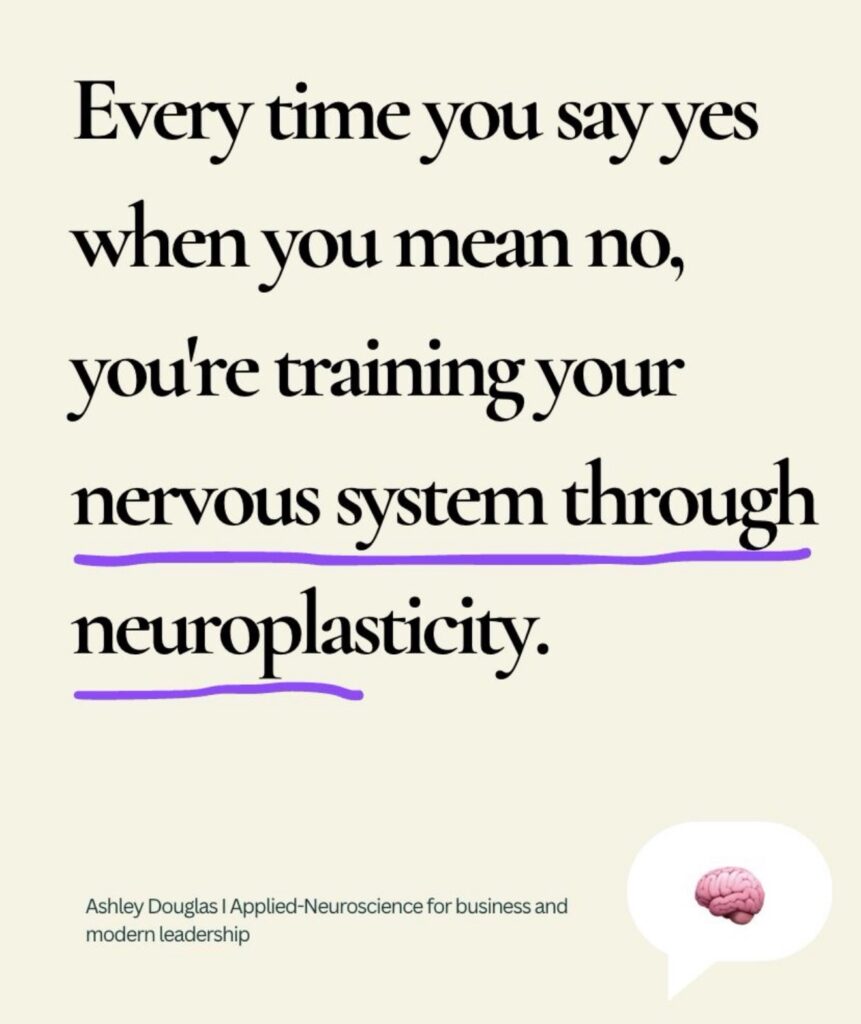
There’s quote circulating right now from applied neuroscientist Ashley Douglas: “Every time you say yes when you mean no, you’re training your nervous system through neuroplasticity.”
It stopped me cold. Not because it’s new information, exactly. Most of us know, intellectually, that people-pleasing is a thing. That saying yes when you mean no is a habit you can unlearn. What hit me was the mechanism. You’re not just being polite. You’re literally rewiring your brain – reinforcing a neural pathway that maps “my real feeling” to “suppress it and comply.”
Now layer on top of that a culture where obligation and guilt aren’t just occasional social pressures – they’re the operating system.
I’m thinking specifically about many East and South Asian families, and the broader immigrant experience more widely. Where love is expressed through sacrifice, and sacrifice is measured by how much of yourself you gave up. Where the highest compliment is “she never caused any trouble.” Where “what do you want?” is almost a rude question – because wanting things for yourself is coded as selfish, ungrateful, Western.
The result? You can become extraordinarily accomplished, and have no idea who you are. Book smart. Emotionally fluent in everyone else’s needs. A master at reading the room. Completely disconnected from your own interior.
I want to be careful here: I don’t think this is malicious. Parents who raised children inside these systems were themselves shaped by survival, by scarcity, by cultures where individual desire really was a luxury they couldn’t afford. The pattern gets passed down not out of cruelty but out of love expressed in the only language available.
But naming it isn’t the same as blaming it. You can hold both things: this came from love, and it also caused harm.
The neuroplasticity piece matters because it reframes the work. It’s not therapy-speak about “healing your inner child.” It’s your nervous system having been trained – like a muscle – to override your own signals.
Which means the path back is also training: small, repeated acts of saying what you actually mean. Not grand confrontations. Just the micro-practice of letting your real answer land before you reflexively smooth it over.
What do you actually want? Not what’s expected. Not what’s safe. What do you want?
If that question makes you anxious – if your mind goes blank or immediately jumps to what someone else needs – that’s information. That blank space? That’s where you get to start.




0 Comments