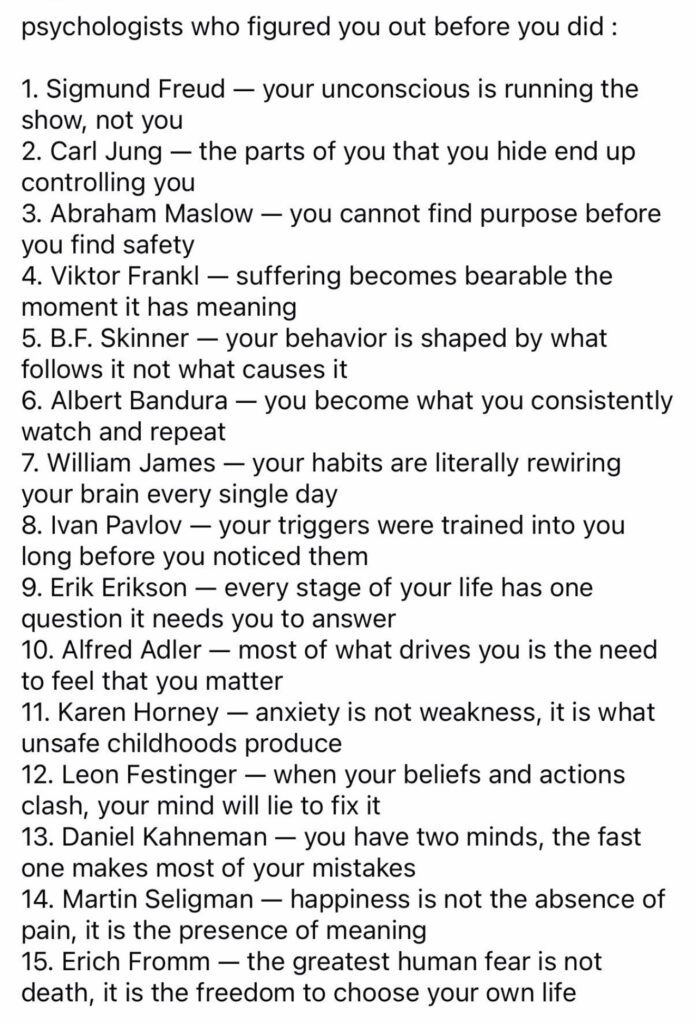
There is a list circulating that names fifteen psychologists alongside a single, devastating sentence about what each one discovered. You have probably seen it. You may have nodded at a few of the lines, felt a flicker of recognition, then scrolled on. That scroll is the thing worth examining.
The list is deceptively casual. It looks like content. It reads like a wellness post. A friend shares it with a heart emoji. Someone screenshots it and captions it “so true.” It disappears into the feed in thirty seconds. Which is a shame, because if you actually stop with any one of those fifteen names and sit inside the idea they represent, it becomes deeply uncomfortable.
Discomfort is usually the sign that something real just landed.
Take Carl Jung first, because his line is the sharpest: the parts of you that you hide end up controlling you. Jung called this the Shadow — not evil, not monstrous, just the unacknowledged. The traits you were punished for as a child, the desires that felt shameful, the anger you learned to perform as helpfulness. You do not eliminate those things by not looking at them. You hand them the steering wheel. Every overcorrection, every inexplicable reaction, every relationship pattern that keeps repeating itself — that is the Shadow driving while you sit in the back seat pretending you are in charge.
Sigmund Freud makes the same argument from a different angle: the unconscious is running the show. His therapeutic methods were flawed and many of his specific theories have not survived empirical scrutiny. The core observation, though, holds. The vast majority of the processing that produces your behavior occurs below conscious awareness. You experience the output — the choice, the feeling, the impulse — and construct a post-hoc story about why you did it. Neuroscience has largely confirmed this much, regardless of what it did to the rest of Freud’s architecture.
Karen Horney cuts straight to something most people resist: anxiety is not weakness, it is what unsafe childhoods produce. Not dramatic abuse. Not visible trauma. Just the ordinary, ambient experience of a child who learned that love was conditional, or that the adults in the room were themselves too frightened to be a reliable source of safety. That child becomes an adult who reads threat into neutral situations, who over-explains, who apologizes preemptively, who cannot fully rest. The anxiety did not appear from nowhere. It was the only rational response to the information that was available.
The Ones People Underestimate
Albert Bandura is on the list as “you become what you consistently watch and repeat,” and people tend to absorb this as a motivational note about habits. It is actually a statement about the porousness of the self. You do not form your identity in a vacuum and then go out and interact with the world. The world is constantly writing into you — your family’s emotional style, the media you consume, the behavior of people you respect or fear. Social learning is not a phase of childhood that ends. It is continuous, largely involuntary, and far more powerful than deliberate self-improvement.
Leon Festinger described cognitive dissonance, summarized here as: when your beliefs and actions clash, your mind will lie to fix it. The lie is automatic. The mind does not tolerate the tension of believing one thing and doing another for long; it resolves the dissonance, usually not by changing the behavior but by quietly revising the belief. This is the mechanism behind almost every instance of self-deception you have ever witnessed in another person and refused to recognize in yourself. The revision is seamless. By the time it has happened, you genuinely believe the new version.
Viktor Frankl survived Auschwitz and came out with an argument that suffering becomes bearable the moment it has meaning. This is often misread as comfort. It is not comfort — it is something harder. It does not promise the suffering will end or that it was fair. It says only that meaningless suffering is the most destructive kind, and that the search for meaning is the one thing that cannot be taken from a person entirely. His book, Man’s Search for Meaning, is one of those texts that reads differently depending on where you are in your life. Each time it hits a different nerve.
What the List Is Really Saying
The thread that runs through all fifteen names is a single, uncomfortable premise: you are less self-authored than you think. Your habits are shaped by reinforcement you did not choose. Your triggers were trained into you before you had language for them. Your sense of what you need, what you fear, what you want, what you believe about yourself — all of it passed through systems and relationships and histories that existed long before you had any say in the matter.
This is either terrifying or liberating, depending on where you are standing. If you read it as determinism, it forecloses agency and becomes an excuse. If you read it as a map, it becomes the most useful thing you have ever been handed. You cannot navigate terrain you refuse to see. The psychologists on this list spent their careers drawing the map. Whether you use it is still up to you — which is, in the end, the point Frankl was making.
The next time the list passes through your feed, do not scroll. Pick one name. Sit with the sentence next to it for sixty seconds. Notice what comes up. That reaction — whatever it is — is the data.



0 Comments